Products · core stock
Used gaylord boxes, graded honestly.
- Grades held
- 1A through 5A
- Footprints
- 16 in gaylords alone
- Typical price
- $6.25 – $13 per box
Check gaylord availability
Size, wall, grade and quantity is all we need. Photographs of the exact lot come back with the quote.
Answer first
What a gaylord box is, in one paragraph.
A gaylord box is a large corrugated bulk container built to sit on a pallet — almost always 48 × 40 inches at the base in North America — in three, four or five wall board, rated to carry between 700 and 2,500 pounds. The name comes from the Gaylord Container Company, which popularised them in the mid-twentieth century; it has been a generic industry term for decades. They are also called bulk bins, pallet boxes, bulk boxes, tote boxes and skid boxes, and the words are used interchangeably on most docks.
Used gaylords are the same containers after one or more trips. Because corrugated fails through moisture, crushing and repeated folding rather than through age, a dry box that has been stored under a roof retains almost all of its original edge crush strength. That is the entire commercial premise of this business — and the reason a 2A used box does the same job as a new one at roughly half the price.
- Typical payload
- 1,500 – 2,500 lb
- 4-wall through 5-wall, on a good pallet.
- Cube of the standard box
- 40 ft³
- 48 × 40 × 36 — about 299 gallons.
- Cheaper than new
- 45 – 65%
- Same specification, before freight.
- Further trips, average
- 3.4
- What our placed stock actually achieves.
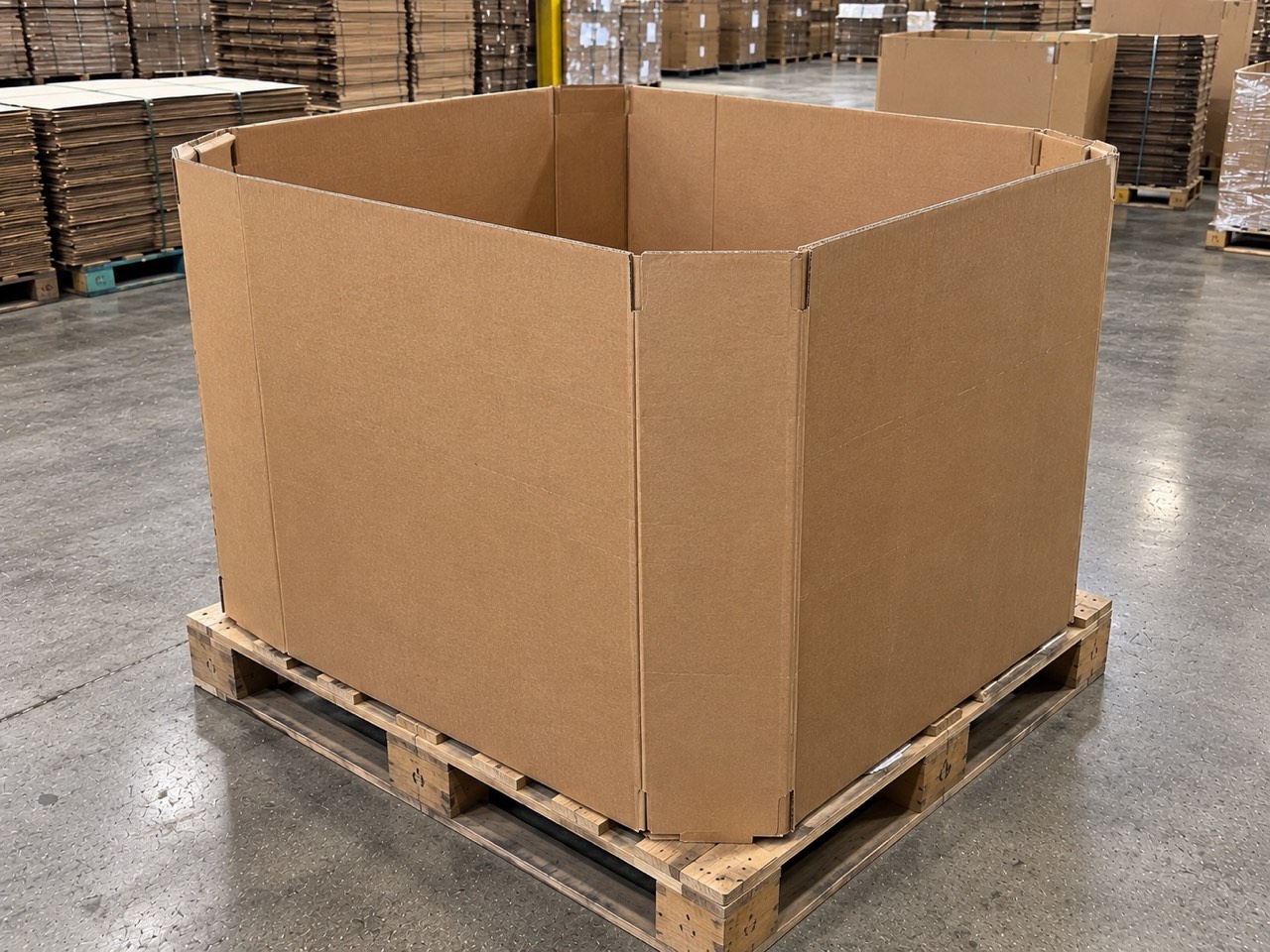
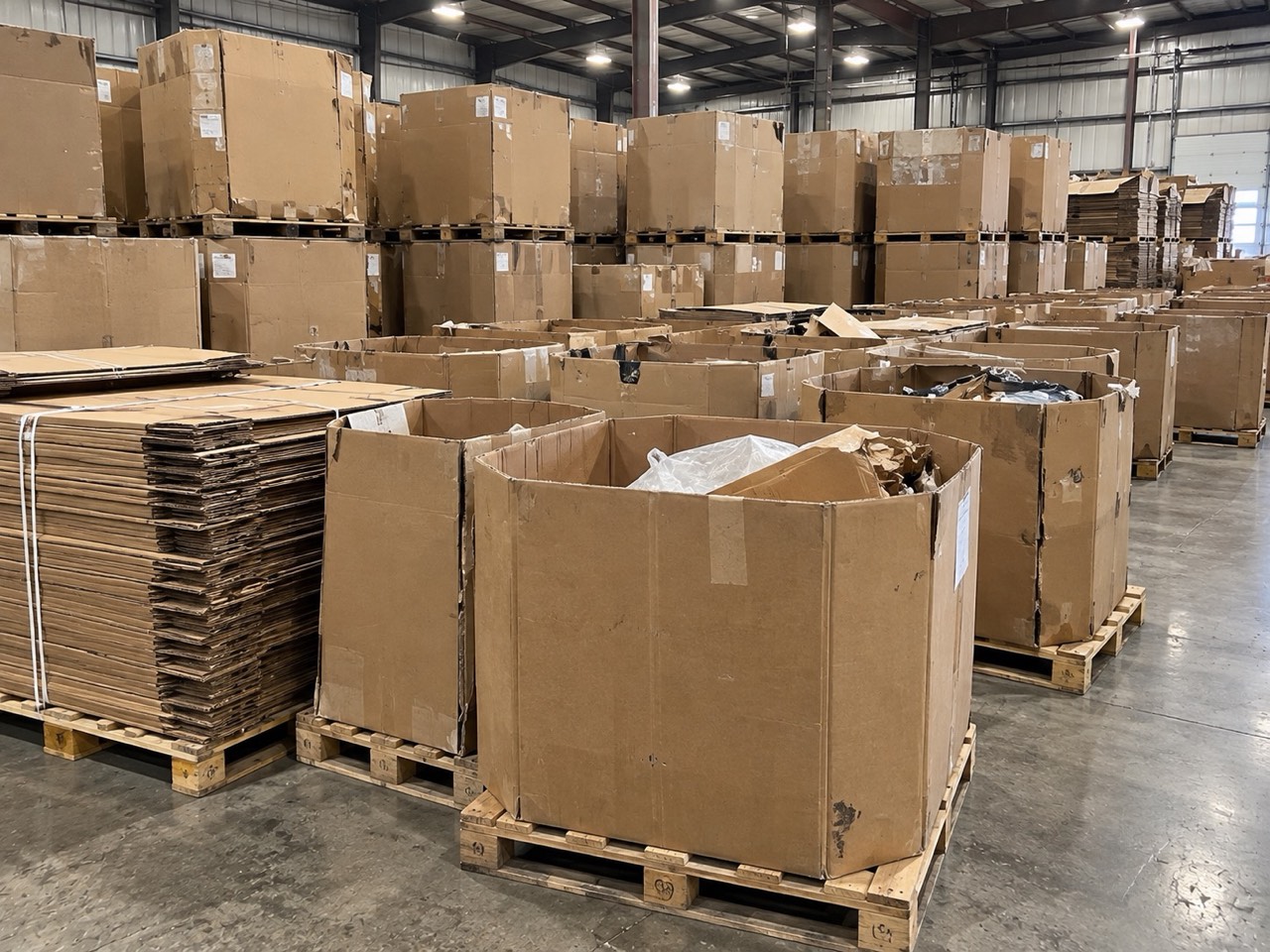
Stock
Eight footprints we almost always have.
Cube, gallons, payload and the job each one is genuinely good at. Sixteen more gaylord footprints and every octabin are on the full size chart.
| Size (L × W × H in) | Wall | Cu ft | Gallons | Payload | Stack | Best at |
|---|---|---|---|---|---|---|
| 48 × 40 × 36 | 5-wall | 40 | 299 | 2,200 lb | 3 high | The default North American gaylord. Plastics regrind, textiles, e-waste, returns processing. |
| 48 × 40 × 36 | 4-wall | 40 | 299 | 1,500 lb | 2 high | Same cube, lighter board. Light bulky goods, foam, apparel, poly film. |
| 48 × 40 × 30 | 4-wall | 33.3 | 249 | 1,400 lb | 2 high | Low-clearance racking and pick lines where operators reach in all day. |
| 48 × 40 × 24 | 4-wall | 26.7 | 199 | 1,200 lb | 2 high | Dense material — metal turnings, glass cullet, batteries — where cube fills long before the weight limit. |
| 48 × 40 × 42 | 5-wall | 46.7 | 349 | 2,400 lb | 2 high | Bulk resin and pellet packing where a taller column still loads under a 53′ trailer roof. |
| 48 × 40 × 48 | 5-wall | 53.3 | 399 | 2,500 lb | 2 high | Maximum practical cube on a standard pallet. Fluff, film, insulation, packing peanuts. |
| 48 × 40 × 34 | 4-wall | 37.8 | 283 | 1,500 lb | 2 high | A very common used size — the one most retail and 3PL returns arrive in. |
| 41 × 28 × 25 | 4-wall | 16.6 | 124 | 900 lb | 2 high | Half gaylord. Fits two to a pallet, or one where aisle space is tight. |
Grades
Five rungs, written down, with reject criteria.
A grade is a promise about what you will find when the trailer doors open. Ours is published in full, including what gets a box rejected at each level — because a vague grade is how the used-packaging industry lost its reputation in the first place.
First use, as-new
Square, clean, unmarked. For anything a customer or a camera sees.
Light use, clean
One or two trips, structurally untouched. The value sweet spot.
Sound, cosmetic wear
Scuffed and relabelled, but stacks and carries to rating.
Repairable
Needs bench work. Sold as-is cheap, or reconditioned at a middle price.
Mixed load
Unsorted by size and grade, priced by the load. For buyers who sort.
Buying
How an order actually runs.
No account setup, no minimum contract, no catalogue codes.
1 · Send the spec
Size, wall, grade, quantity and destination ZIP. If you do not know the spec, describe the material and the weight instead.
Form or email
2 · We walk the floor
A buyer checks the actual bands in stock, photographs the lot you would receive, and prices it delivered.
Same or next business day
3 · You approve
One pallet or thirty truckloads. Payment terms on approved accounts, card or ACH otherwise.
Nothing auto-ships
4 · It loads
Banded, wrapped, load-checked and photographed at the door. Our trucks in fourteen states, LTL or truckload everywhere else.
Typically 2–5 business days
What is the most common used gaylord box size?
How much weight can a used gaylord box hold?
Can I buy a single pallet of gaylord boxes?
Do used gaylord boxes come with lids and liners?
How are they shipped?
What is the difference between 4-wall and 5-wall?
Anatomy
Every part of a gaylord box, and what fails first.
Buying used well means knowing which components wear, which can be replaced and which end the container's life. These are the eight parts our graders inspect individually.
- Side walls
- The load-bearing structure. Flutes run vertically so the corrugation acts as a column. Scuffs and labels do not matter; crushing and delamination end the box.
- Vertical edges
- Where four walls meet. These carry the stack. A crushed or rounded edge is an automatic downgrade and cannot be repaired.
- Bottom edge
- Where load exits into the pallet. 61% of all our rejections trace here — from overhang, fork contact or moisture wicking off a slab.
- Base panel
- Sags between deck boards under heavy loads. Seven or more top deck boards, or a slip sheet, prevents the score lines that eventually crack.
- Manufacturer's joint
- The vertical seam, taped, stitched or glued. Opened joints are the most common repairable failure and take about twenty minutes on the bench.
- Flaps
- Top and bottom closures. Split or missing flaps are repairable with patch stock; the box loses nothing structurally once patched.
- Corner tabs
- On sleeve-and-base constructions, these locate the body. Damaged tabs are repairable; a damaged base usually is not.
- Box certificate
- The round stamp on a bottom flap. Evidence of the original spec, not authority on current condition — we rate from measurement instead.
- Score lines
- Creases the board folds along. Repeated folding is one of the three genuine causes of wear, alongside moisture and crushing.
Before you order
Eleven things worth knowing that nobody tells first-time buyers.
Collected from the questions we answer most often on first orders — and the mistakes that cost customers money in the first quarter.
- 01
Flattened and assembled are different products
A trailer holds 26 assembled gaylords or 550–700 flattened. If you can re-erect boxes on site, flattening cuts your freight per box by a factor of twenty or more. Ask for both prices.
- 02
The pallet matters more than the grade
A 2A box on an undersized pallet grades 4A within three months. Measure five of your pallets with a tape before you spend anything on better boxes.
- 03
Payload ratings assume dry, aligned, short-term
Published figures come from laboratory conditions. In an unconditioned warehouse in August, apply roughly half. We publish the derating multipliers in full.
- 04
Liners let you drop a grade
A two-dollar liner isolates product from a scuffed interior, which makes cosmetic condition irrelevant. The grade difference it saves is four to five dollars.
- 05
Mixed-grade orders cost us nothing
2A for outbound, 3A for internal handling, banded and labelled separately on the same delivery. Most customers do not realise this is available.
- 06
Availability is genuinely finite
Used stock is a by-product of somebody else's production. January and February are tight on the standard 48 × 40 × 36; November has the widest choice of the year.
- 07
We buy them back
Which gives your containers a residual value at end of life rather than a disposal cost. On a five-wall box that is a swing of two to three dollars.
- 08
Single-source lots exist
If line consistency matters, ask for boxes from one original manufacturer and one previous user. It costs more than general graded stock and far less than new.
- 09
Height is cheaper than you think
The price difference between a 36 and a 48 inch box is usually under three dollars, while the cube difference is 33%. For light bulky product, always buy the taller box.
- 10
Weight limits bind before cube above 45 lb/ft³
Dense material fills the rating long before the box. Shallow 24 and 30 inch boxes exist specifically for this and are cheaper than the standard.
- 11
One pallet is a real order
Twenty to twenty-five flattened boxes. Nobody reputable will push you to a truckload before you have checked a pallet against the written grade.
Troubleshooting
If your boxes are failing, it is one of these nine things.
Sorted by how often we find each cause when a customer tells us their containers are not lasting.
| Symptom | Most likely cause | How to confirm | Fix |
|---|---|---|---|
| Bottom edge crushed within weeks | Pallet overhang | Measure five pallets across the top deck, both ends | Match the pallet; nothing under 47¾ × 39¾ |
| Bulging bottom course in a stack | Creep from humidity or storage time | Check ambient RH and how long the stack has stood | Derate and stack two high; rotate stock |
| Boxes go out of square | Overloading, or stacking flattened too high | Measure both diagonals across the top opening | Stay inside the rating; nine bands maximum |
| Soft or spongy board | Moisture above 12% | Pin-type moisture meter on the bottom course | Roof, pallets under everything, 18 in off exterior walls |
| Triangular scuffs on bottom corners | Fork tips on side entry | Watch one shift of put-away | Block pallets, or standardise approach direction |
| Base panel cracking along lines | Deck board sag under heavy loads | Look for score lines matching deck board gaps | Seven-plus top deck boards, or a slip sheet |
| Seams opening after one trip | Re-glued or damaged manufacturer's joint | Inspect the vertical seam on arrival | Reject on inbound; repairable on our bench |
| Liner tearing on discharge | Gauge too light for the material | Check gauge against abrasion, not product value | Step to 5–6 mil for regrind and abrasive material |
| Only one trip achieved | Cut discharge ports | Ask the line operator | Tip, vacuum or remove the cap instead |
One pallet is enough to find out.
Order a single banded lot, check it against the grade description, and scale up only if it matches. Most customers do exactly that.