Circularity & impact
The greenest box is the one nobody had to make.
- Landfill, since 2019
- Zero tons
- Avg further trips
- 3.4 per box placed
- Reporting
- Quarterly, auditable
Request your diversion data
Already buying from us? Ask for a quarterly diversion statement. Not yet? Tell us your volumes and we will model it.
Answer first
Reuse sits one whole rung above recycling — and almost nobody is operating that rung.
The short version: reusing a corrugated bulk container avoids roughly 23 lb of CO₂e, 65 gallons of process water and 24 lb of landfill mass per cycle, compared with buying an equivalent new box and discarding the old one. Recycling the same box recovers a meaningful but much smaller share of that, because repulping still consumes water, heat and freight — and shortens the fibre every time.
The EPA's own waste management hierarchy ranks source reduction and reuse above recycling, which is above energy recovery, which is above disposal. Corrugated recycling in the United States is a genuine success story, with recovery rates that most materials would envy. Reuse, however, has barely been industrialised at all — not because the boxes fail, but because sorting, grading, storing and hauling used containers is slow, physical, unfashionable work with thin margins.
That gap is the company. We built a business inside the rung everyone skipped.
- CO₂e avoided per reuse
- ≈ 23 lb
- Versus manufacturing an equivalent new five-wall box from virgin fibre.
- Process water not drawn
- ≈ 65 gal
- Pulping, forming and drying water that never has to be used.
- Further trips per box
- 3.4×
- Measured across placed stock over the last two years.
- Pulping cycles in fibre
- 5 – 7
- Every reuse is a pulping cycle the fibre does not spend.
Model your own volume
Your numbers, not ours.
Put your real monthly volume in. The ledger below is the same calculation that sits behind the quarterly statements we issue to customers.
The Second-Life Ledger
What does keeping boxes in play actually buy you?
Set your real numbers. Everything to the right is one year of reuse compared with buying the same boxes new and landfilling them once.
Our graded stock averages 3–4 further trips. Reconditioned 4A stock often clears 6.
Reuse events per year
14,400
4,800 boxes, each doing 3 more jobs before recycling.
- CO₂e avoided
- 164.2 tons
- Water not drawn
- 933,120 gal
- Trees left standing
- 2,938
- Kept out of landfill
- 172.8 tons
Which is also
$165,600 of packaging budget not spent on new board — and roughly 30.0 truckloads of boxes that never had to be manufactured, wrapped and shipped to you in the first place.
Figures use 0.95 lb CO₂e and 2.7 gal of process water per pound of containerboard avoided, and 17 trees per ton of virgin fibre. Every assumption, with sources and the cases where it is conservative, is written out on the reuse-math page.
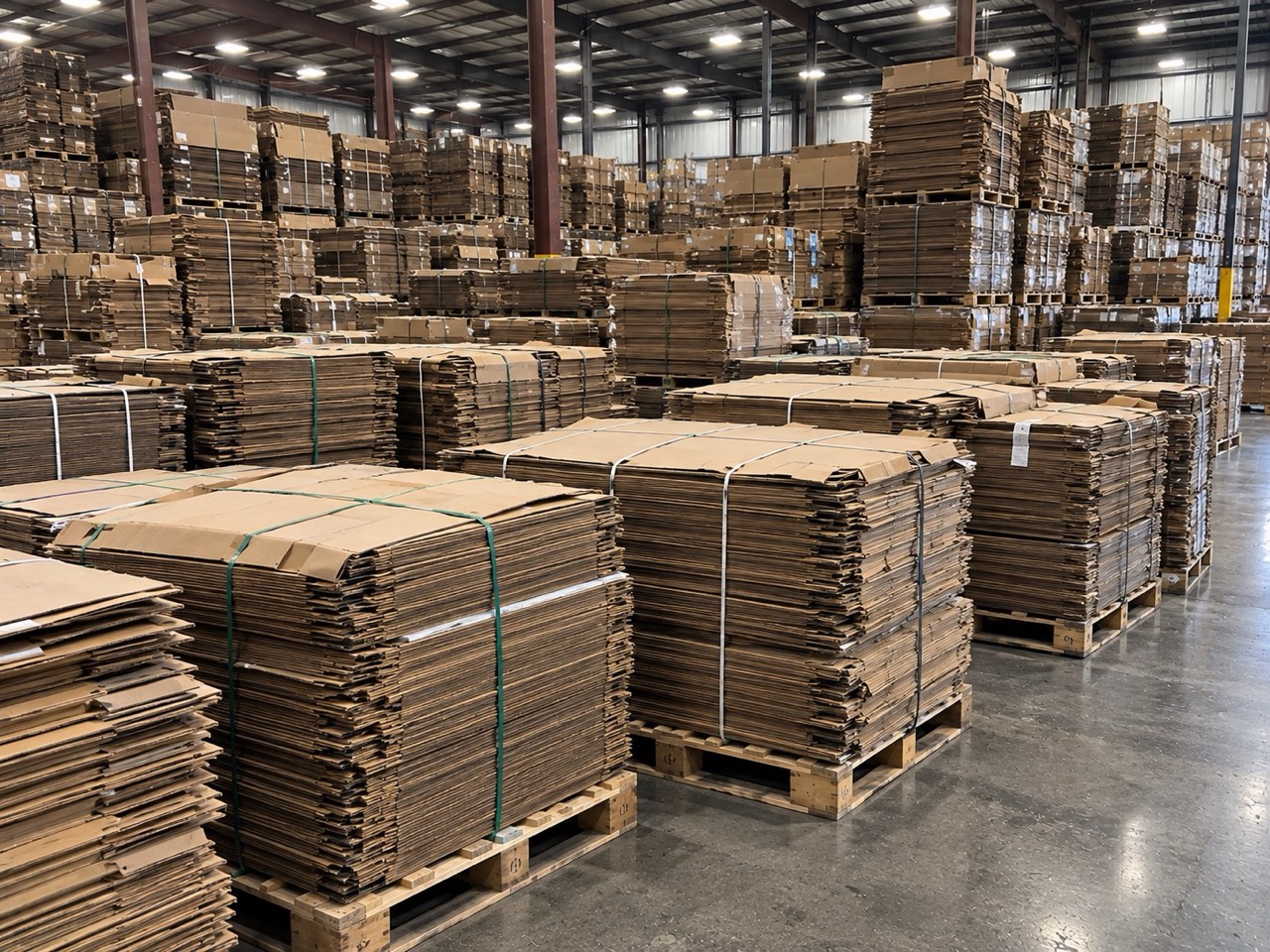
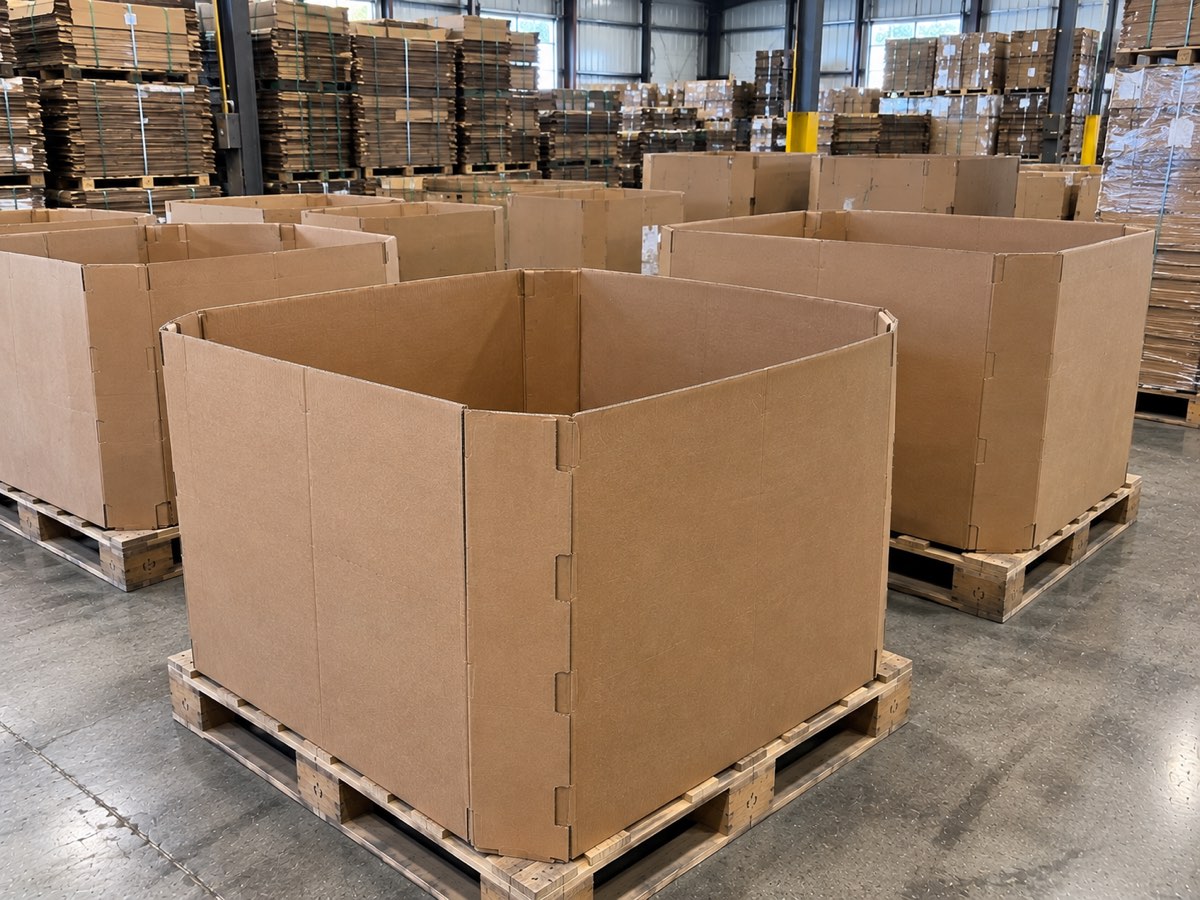
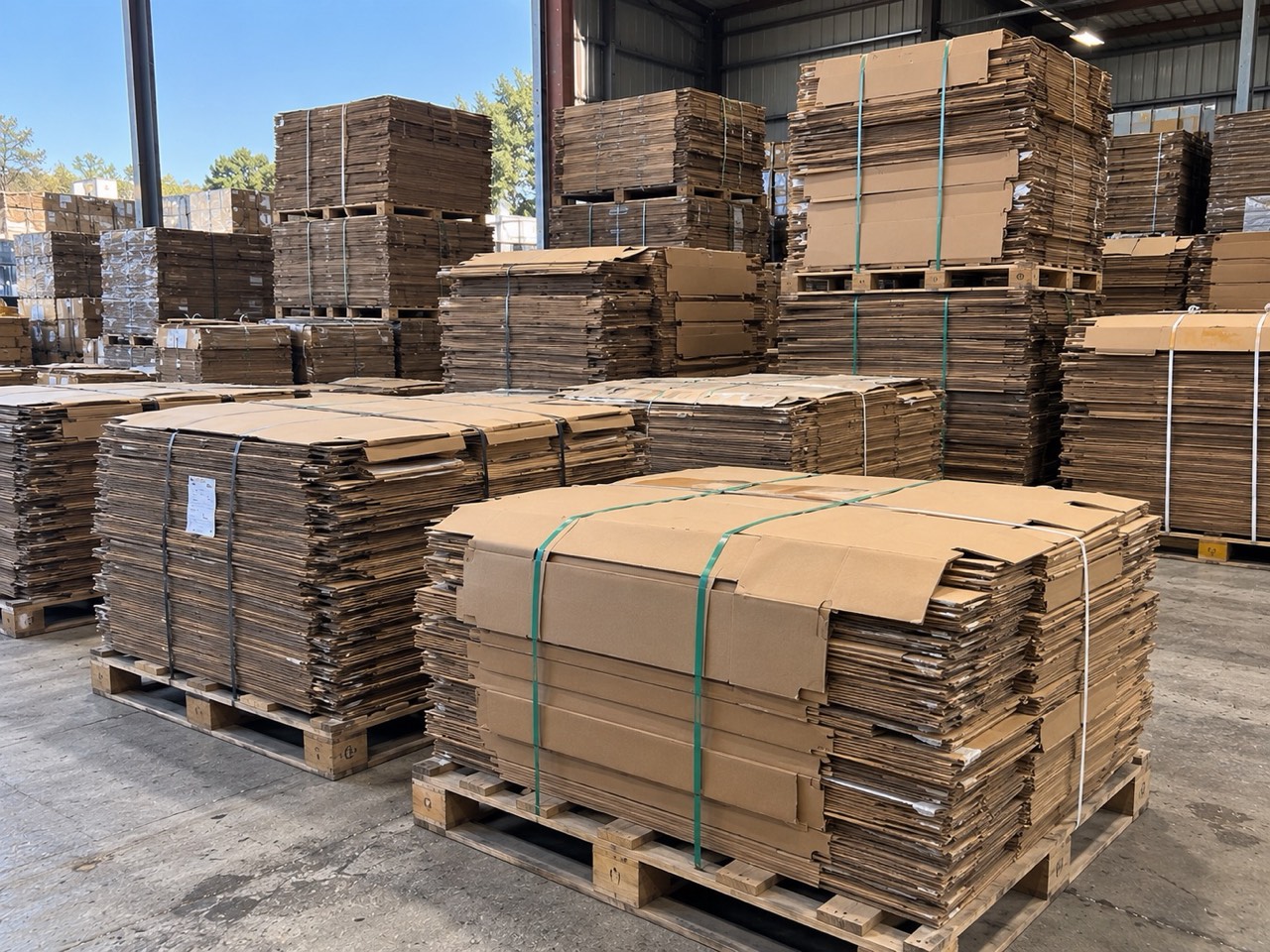
The hierarchy, applied
Four exits from this building, in strict order of preference.
Every box that arrives takes exactly one of these. Which one is decided by a grader, not by whichever is easiest that afternoon.
- 01
1 · Reuse as-is
Graded, banded and sold to run again. Around 71% of inbound volume leaves this way. Highest environmental value, and the reason the company exists.
- 02
2 · Recondition, then reuse
Re-taped, re-stapled, patched or re-sleeved on the bench. Roughly 12% of inbound. A box that would have been baled instead makes two or three more trips.
- 03
3 · Fabricate into something else
Sound panels cut into pads, dividers, trays and display bases. About 6%. Keeps the fibre in its highest-value form for longer and replaces virgin die-cut stock.
- 04
4 · Bale as mill-spec OCC
Only when the board is genuinely spent or contaminated. Around 11%, weighed and sold back to paper mills as feedstock. Documented to the pound.
There is no fifth exit. No landfill line item, no waste-to-energy contract, no "miscellaneous disposal". If a load arrives contaminated to the point that none of the four routes is available, we refuse it at the dock rather than quietly absorb it — which happens perhaps four or five times a year.
Where we refuse to overclaim
Three honest caveats.
Reuse companies have every incentive to inflate their numbers. Here are the places ours are softer than they look.
A number you cannot defend in an audit is worse than no number at all. If it is an estimate, it is labelled as one.
Freight is real and we count it
Moving used boxes burns diesel. We net transport emissions off the avoided-manufacturing figure using lane distance and matched backhaul share rather than pretending reuse is free. It is still overwhelmingly positive — just not as positive as the headline number alone.
Counterfactuals are assumptions
'Avoided' savings assume that without us you would have bought a new equivalent box and disposed of the old one. For most customers that is exactly what happened previously; for a few it is not, and we say so in the statement.
Our factors are industry averages
Containerboard carbon and water intensity vary by mill, energy mix and recycled content. We publish the factor set we use, note that it sits mid-range, and update it when better data is available rather than when it flatters us.
Go deeper
The working, and the paperwork.
The reuse math, shown
Every factor, every unit conversion and every assumption behind the ledger — written out so an auditor can disagree with it specifically.
Methodology
OpenDiversion data for ESG teams
What the quarterly statement contains, which frameworks it maps to, and how to hand it to a reporting consultant without rework.
Reporting
OpenWhat happens to a retired gaylord
Follow one box from reject bench to baler to mill, with the weights and the destinations.
Article
Open
Is reusing a box really better than recycling it?
How many times can a gaylord box actually be reused?
What happens to boxes that cannot be reused?
Can I use your numbers in my company's sustainability report?
Do reused boxes count toward recycled-content targets?
Put a real number on your packaging footprint.
Send your monthly volumes and we will model the diversion, the avoided carbon and the cost difference against what you buy new today.