Services · transport
Owning the trucks is why used boxes are affordable.
- Core lanes
- 14 states
- Backhaul share
- 38% of our miles
- Equipment
- Van, flatbed, liftgate, roll-off
Price a lane
Origin, destination, what is moving and roughly how much. We will quote the lane and tell you if flattening changes the answer.
Answer first
Three levers decide whether a used-box lane works.
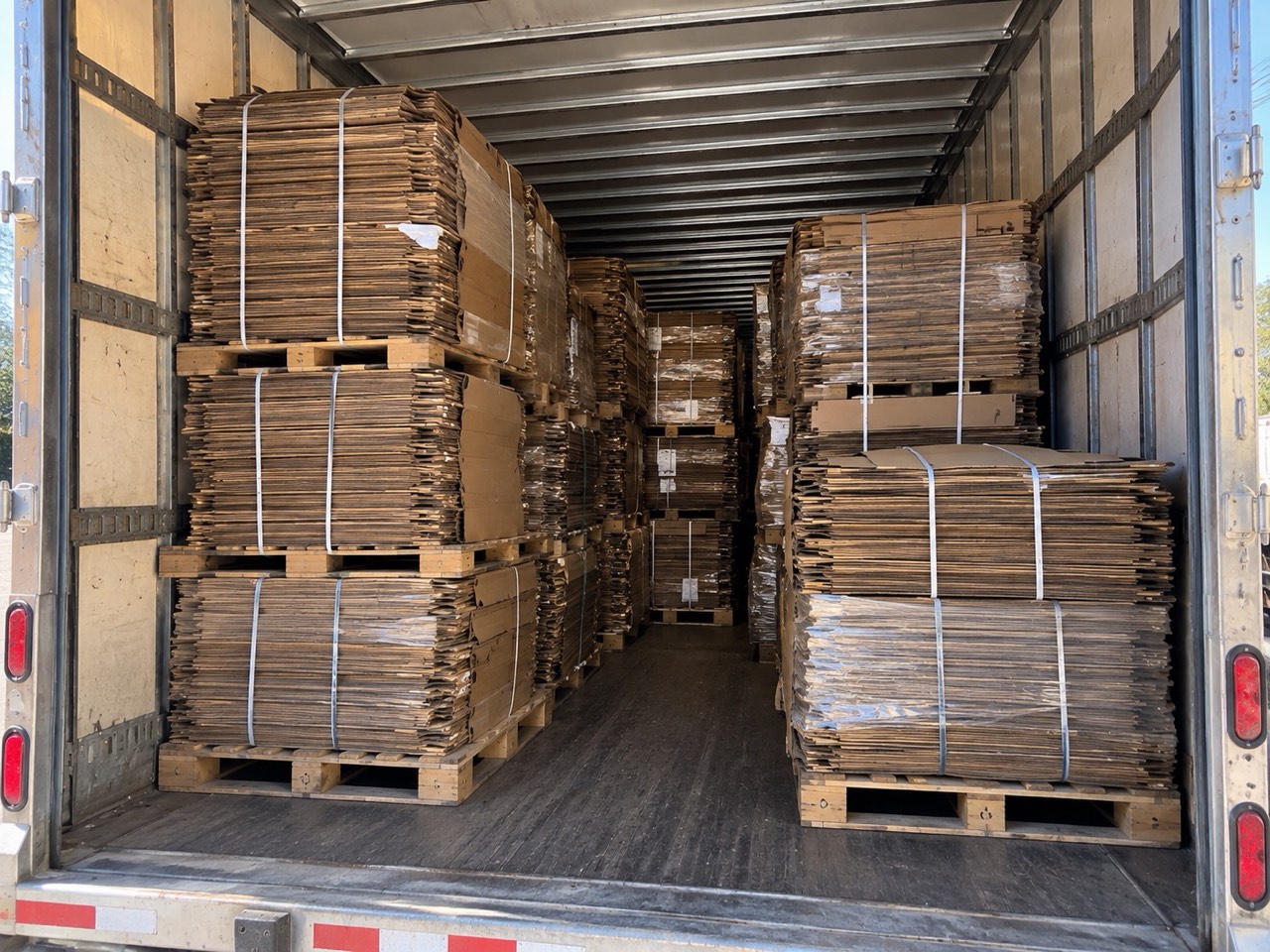
- Flattening. It roughly triples what fits on a trailer. On a 400-mile lane that is the difference between a viable programme and an expensive gesture.
- Backhaul matching. Thirty-eight per cent of our miles are on trucks that were already running the lane. Those moves carry a fraction of the cost and a fraction of the emissions.
- Consolidation. Combining a collection and a delivery on one visit — we take your empties out and leave graded stock behind — halves the freight on both.
- Floor positions
- 26
- 48 × 40 boxes on a 53′ dry van, assembled.
- Double stacked
- 52
- Where grade, payload and product allow it.
- Flattened per trailer
- 550 – 700
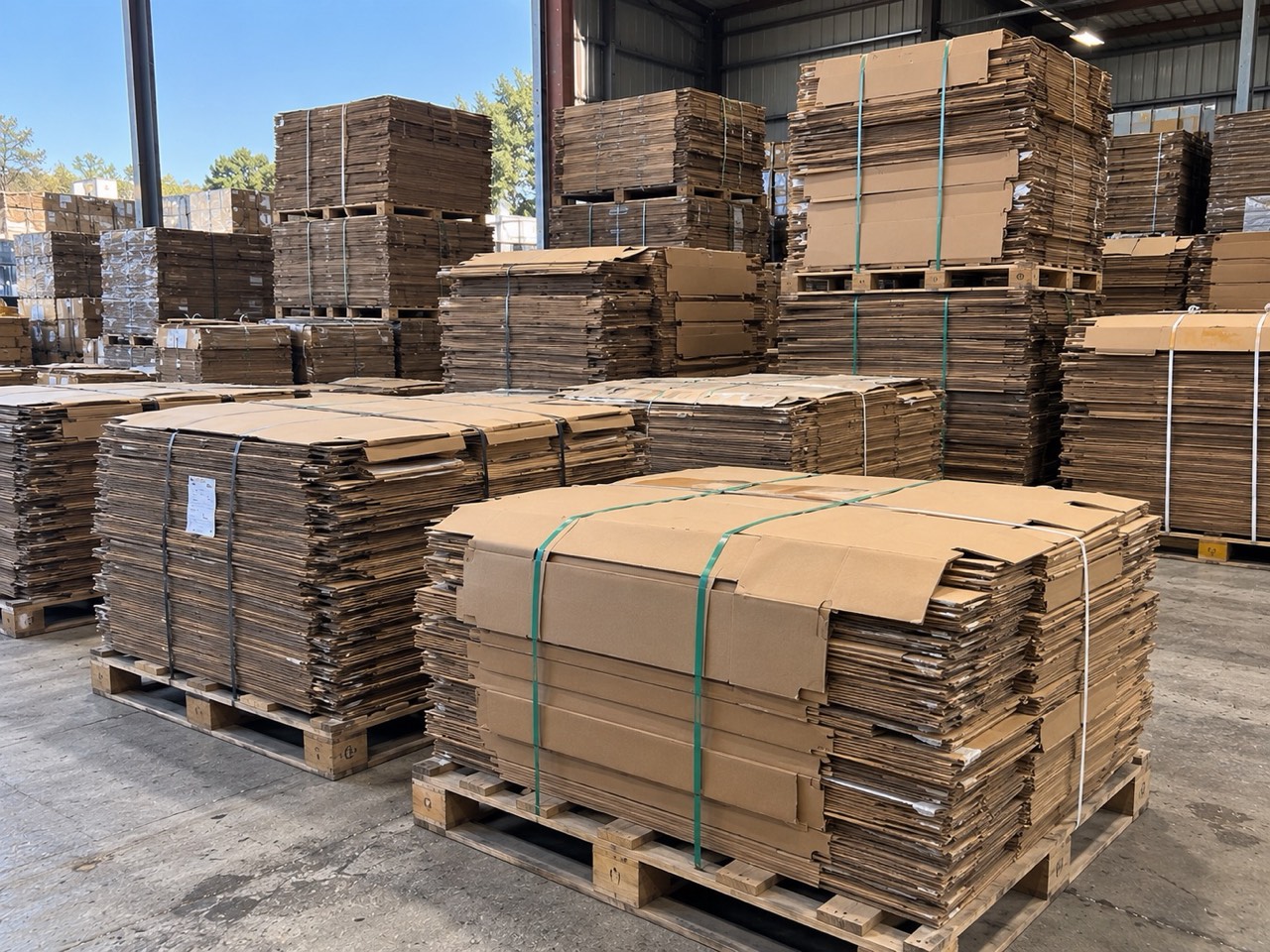
- Banded five-wall, depending on band height.
- Miles on backhaul
- 38%
- Matched to trucks already running the lane.
Equipment
What we can put at your dock.
| Equipment | Capacity | Best for | Site requirement |
|---|---|---|---|
| 53′ dry van | 26 positions / 550 – 700 flattened | Standard collections and deliveries | Dock or forklift and leveller |
| 48′ flatbed | 44,000 lb | Baled OCC, banded pallet lots | Forklift, side access |
| 26′ box truck, liftgate | 12 – 14 assembled gaylords | Sites with no dock; small clearances | Ground-level access |
| Roll-off container, 30 / 40 yd | Staged accumulation | Cleanouts over several days or weeks | Hard standing, clear drop area |
| Partial truckload | Shared trailer space | 4 – 15 pallets on core lanes | Standard dock |
| LTL | 1 – 6 pallets | Small orders outside core lanes | Standard dock or liftgate booked |
Questions
Freight, answered.
Why is freight such a big part of the cost of used boxes?
How many flattened gaylords fit on a 53 foot trailer?
Can you collect from sites without a dock?
Do you ship outside your core lanes?
Load planning
Six configurations and when each one is right.
Getting this wrong costs more than any other single decision in used packaging, because freight is often larger than the value of what is on the trailer.
| Configuration | Capacity | Use when | Requirement | Risk |
|---|---|---|---|---|
| Floor-loaded single layer | 26 assembled | Product is heavy; you will weigh out | Alignment only | Wasted height if product is light |
| Double stacked | Up to 52 | Product is light; you will cube out | 5-wall, 2A/3A, aligned, under ~1,400 lb | Collapse if misaligned or damp |
| Palletised single | 26 pallets | Mixed loads, fast unloading | Matched pallets, no overhang | Pallet weight eats payload |
| Flattened, banded | 550 – 700 | Empty box delivery or collection | Banding, nine bands maximum | Crush in the bottom bands if stacked higher |
| Mixed flat and assembled | Varies | Combined delivery and collection | Load plan agreed in advance | Complexity on the dock |
| Partial / shared | 4 – 15 pallets | Small orders on core lanes | Flexible delivery window | Longer transit |
Site information
Nine things to tell us before a truck is booked.
Each one of these has, at some point, turned a forty-minute collection into a wasted trip.
- Dock or ground level — and whether a liftgate is needed
- Dock leveller present, and its weight rating
- Trailer access: gate, approach angle, turning space, overhead clearance
- Your quiet hours, so we do not compete with your own inbound
- Check-in procedure and where the driver reports
- PPE requirements and whether drivers may be on the dock
- A named contact who will actually be there that day
- Any appointment system and how far ahead it books
- Whether a forklift and operator are available, or we bring our own
Lane economics
Why the same order costs different amounts.
Delivered pricing is genuinely lane-specific. Published here so it reads as arithmetic rather than as inconsistency.
- 01
Backhaul availability
Thirty-eight per cent of our miles run on trucks already making the journey. A lane with regular return capacity prices at a fraction of a headhaul lane — which is why a closer destination sometimes costs more.
- 02
Direction of trade flow
Freight into a region is cheaper when that region exports less than it imports, and vice versa. It has nothing to do with distance and everything to do with what else is on the road.
- 03
Seasonality
Backhaul availability collapses during agricultural harvest and in the weeks before Christmas. A lane that is cheap in May can be forty per cent dearer in October with no change to the boxes.
- 04
Flexibility
A two-day delivery window frequently puts a load on a return leg instead of a dedicated run. It is the cheapest concession a buyer can make.
- 05
Load efficiency
480 and 690 flattened boxes cost nearly the same to move. Rounding up to a trailer-efficient quantity usually lowers the per-box price.
- 06
Consolidation
Collection and delivery on one visit removes thirty to forty per cent of the freight on both legs, and roughly halves the emissions per container.
Ask us to combine your inbound and outbound.
One visit, empties out and graded stock in. It is cheaper for you, cleaner for the atmosphere, and it is how our best accounts run.