Sizes & specs
The gaylord size chart, with the numbers people actually need.
- Footprints listed
- 22
- Standard box
- 48 × 40 × 36 — 40 ft³
- Dimensions quoted
- Outside, always
Ask about a size
Found the row you need? Put it in Product Type with a quantity and we will check availability against this week's floor.
Answer first
One size dominates, and four heights cover almost everything else.
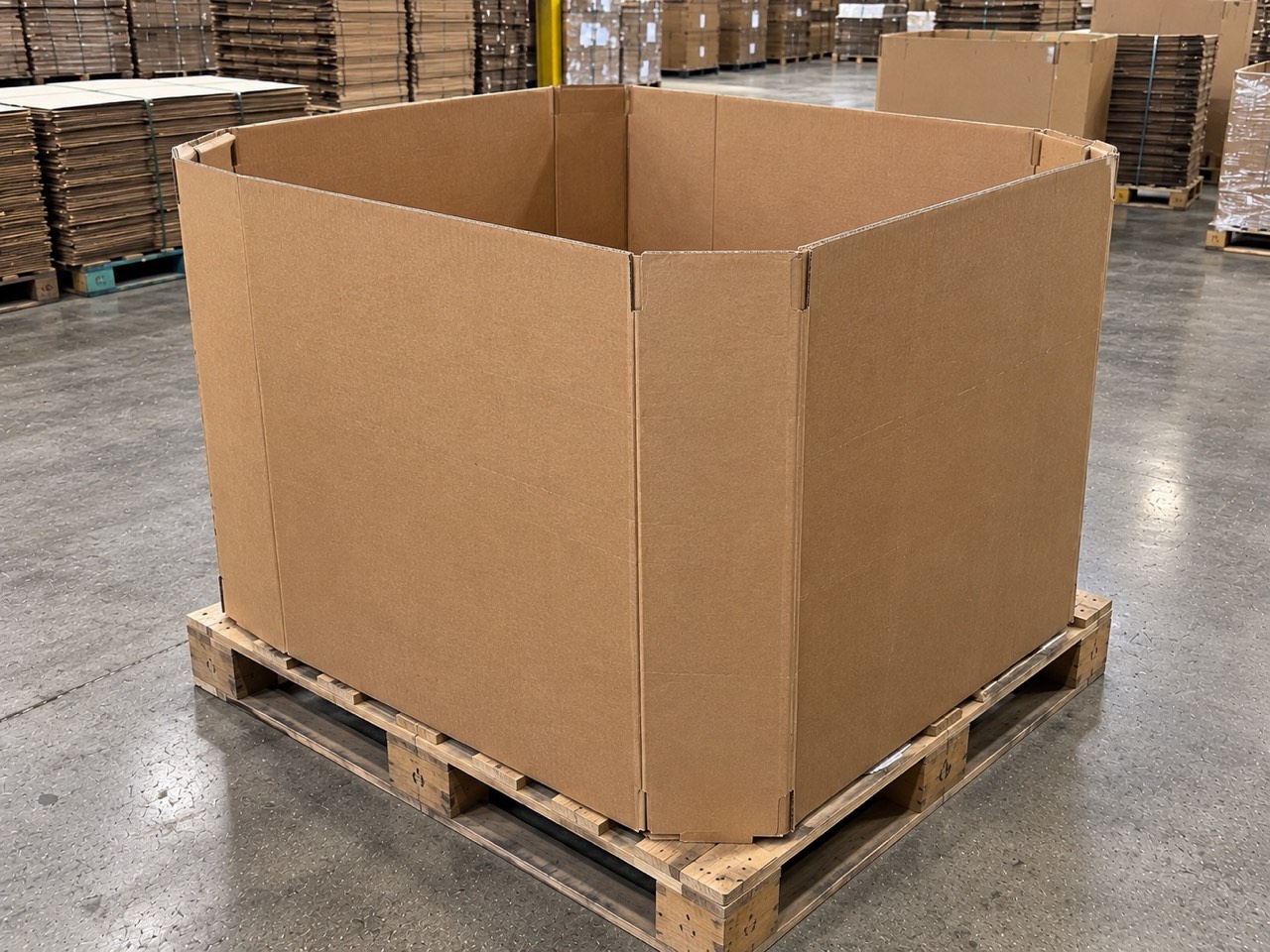
The default gaylord is 48 × 40 × 36 inches: forty cubic feet, roughly 299 gallons, sitting exactly on a GMA pallet, rated near 2,200 lb in five-wall board. Change only the height — 24, 30, 34, 42 or 48 inches — and you have covered perhaps 85% of the bulk boxes in North American industry.
Everything else on this chart exists for a specific reason: a square footprint for centre-fed filling, a round body for material that bridges, a half size for tight aisles, a metric-adjacent footprint for imported chemical packaging. Knowing why each exists is usually faster than searching by dimension.
All dimensions here are outside dimensions, measured across the base with the box square. Internal volume is roughly 3–5% lower depending on wall thickness, and we quote practical fill at 85–92% rather than theoretical cube.
The chart
Filter twenty-two footprints.
Sorted by cube, largest first. Filters narrow the table instantly — and the complete chart is rendered on the page regardless, so it prints and reads fine without JavaScript.
22 of 22 footprints shown
| Size (L × W × H in) | Wall | Cu ft | Cu yd | Gallons | Payload | Stack | Pallet | Typical use |
|---|---|---|---|---|---|---|---|---|
| 48 × 40 × 60 | 5-wall | 66.7 | 2.47 | 499 | 2,000 lb | 1 high | 48×40 GMA | Oversize single-trip box for lightweight bulky scrap. Rare, and usually built to order. |
| 48 × 40 × 48 | 5-wall | 53.3 | 1.98 | 399 | 2,500 lb | 2 high | 48×40 GMA | Maximum practical cube on a standard pallet. Fluff, film, insulation, packing peanuts. |
| 45 × 45 × 42 | 5-wall | 49.2 | 1.82 | 368 | 2,300 lb | 2 high | 48×48 | Square footprint for centre-fed filling heads and rotating discharge. |
| 48 × 40 × 44 | 5-wall | 48.9 | 1.81 | 366 | 2,400 lb | 2 high | 48×40 GMA | Auto interior trim, seat foam, blow-moulded parts — big cube, modest weight. |
| 48 × 40 × 42 | 5-wall | 46.7 | 1.73 | 349 | 2,400 lb | 2 high | 48×40 GMA | Bulk resin and pellet packing where a taller column still loads under a 53′ trailer roof. |
| 48 × 45 × 34 | 4-wall | 42.5 | 1.57 | 318 | 1,600 lb | 2 high | 48×45 | Overhanging automotive box sized to a 48×45 rack, not to GMA. |
| 44″ round × 48round | 3-wall | 42.2 | 1.56 | 316 | 2,000 lb | 2 high | 48×40 GMA | Tall octabin for high-volume compounding lines with overhead fill. |
| 44 × 44 × 36 | 4-wall | 40.3 | 1.49 | 302 | 1,800 lb | 2 high | 48×48 | Food-grade dry ingredient box; square so liners drop in without bunching. |
| 48 × 40 × 36 | 5-wall | 40 | 1.48 | 299 | 2,200 lb | 3 high | 48×40 GMA | The default North American gaylord. Plastics regrind, textiles, e-waste, returns processing. |
| 48 × 40 × 36 | 4-wall | 40 | 1.48 | 299 | 1,500 lb | 2 high | 48×40 GMA | Same cube, lighter board. Light bulky goods, foam, apparel, poly film. |
| 47 × 39 × 37 | 5-wall | 39.2 | 1.45 | 294 | 2,100 lb | 3 high | 1200×1000 mm | Metric-adjacent import box (1200×1000 mm). Shows up in chemical and pharma inbound. |
| 48 × 40 × 34 | 4-wall | 37.8 | 1.4 | 283 | 1,500 lb | 2 high | 48×40 GMA | A very common used size — the one most retail and 3PL returns arrive in. |
| 48 × 40 × 30 | 4-wall | 33.3 | 1.23 | 249 | 1,400 lb | 2 high | 48×40 GMA | Low-clearance racking and pick lines where operators reach in all day. |
| 44″ round × 36round | 3-wall | 31.7 | 1.17 | 237 | 1,800 lb | 3 high | 48×40 GMA | Octabin. Free-flowing resin, powders and granulate that would bridge in a corner. |
| 35 × 35 × 43 FIBC | 4-wall | 30.5 | 1.13 | 228 | 2,200 lb | 1 high | 40×40 | Bulk bag footprint, quoted here for comparison when customers weigh bag vs box. |
| 38″ round × 42round | 3-wall | 27.6 | 1.02 | 206 | 1,500 lb | 2 high | 42×42 | Narrow octabin that ships two-abreast in a dry van with room to strap. |
| 36 × 36 × 36 | 4-wall | 27 | 1 | 202 | 1,100 lb | 2 high | 40×36 | Cube box for mixed scrap, shredded paper and sample lots. |
| 48 × 40 × 24 | 4-wall | 26.7 | 0.99 | 199 | 1,200 lb | 2 high | 48×40 GMA | Dense material — metal turnings, glass cullet, batteries — where cube fills long before the weight limit. |
| 48 × 40 × 20 | triple-wall | 22.2 | 0.82 | 166 | 1,500 lb | 3 high | 48×40 GMA | Shallow tray box for heavy castings and stamped metal. |
| 40 × 28 × 30 | 4-wall | 19.4 | 0.72 | 145 | 950 lb | 2 high | 42×30 half | Half-pallet box for retail back-of-store and small-batch recycling. |
| 41 × 28 × 25 | 4-wall | 16.6 | 0.62 | 124 | 900 lb | 2 high | 42×30 half | Half gaylord. Fits two to a pallet, or one where aisle space is tight. |
| 30 × 30 × 30 | 3-wall | 15.6 | 0.58 | 117 | 700 lb | 2 high | 32×32 | Bench-side collection box. Reuse candidate long after it is too small for a line. |
Conversions
The arithmetic, so you do not have to look it up.
| To get | From | Multiply by | Example |
|---|---|---|---|
| Cubic feet | Cubic inches (L × W × H) | ÷ 1,728 | 48 × 40 × 36 = 69,120 in³ = 40.0 ft³ |
| Cubic yards | Cubic feet | ÷ 27 | 40.0 ft³ = 1.48 yd³ |
| US gallons | Cubic feet | × 7.48 | 40.0 ft³ = 299 gal |
| Litres | Cubic feet | × 28.32 | 40.0 ft³ = 1,133 L |
| Load weight | Cubic feet × density | lb/ft³ | 40 ft³ × 35 lb/ft³ = 1,400 lb of resin |
| Round box volume | π × r² × H | ÷ 1,728 | 44″ round × 36 = 31.7 ft³ |
| Practical fill | Gross cube | × 0.85 – 0.92 | 40.0 ft³ → 34 – 37 ft³ realistic |
Choosing
Pick by density first, cube second, height last.
Dense material, over 60 lb/ft³
Metal, glass, castings, aggregate. The weight limit arrives long before the box is full, so buy shallow — 24 or 30 inch — and stop fighting the physics.
Try 48 × 40 × 24
Mid-density, 20 – 60 lb/ft³
Resin, regrind, compounded granulate, food ingredients. The standard 36 inch box is almost always the right answer, in five wall.
Try 48 × 40 × 36
Light and bulky, under 20 lb/ft³
Film, foam, textiles, loose paper, insulation. Buy the tallest box your dock clearance and trailer roof allow.
Try 48 × 40 × 48
Free-flowing
Anything that behaves like a fluid and bridges in corners. Take the cube penalty and use a round octabin body instead.
Try 44″ round × 36
Tight aisles or split loads
Retail back-of-store, small-batch recycling, lab and pilot lines. Half gaylords take two to a pallet position.
Try 41 × 28 × 25
Imported or metric equipment
Lines built around 1200 × 1000 mm pallets will fight a 48 × 40 box every time. Buy the footprint the equipment expects.
Try 47 × 39 × 37
Go deeper
Nine references behind this chart.
How to measure a gaylord box
Inside versus outside dimensions, where to put the tape, and the three measurements that actually matter.
Guide
OpenStacking & load ratings
Edge crush, box compression, safety factors and why a rating halves after ninety days in storage.
Guide
OpenPallet compatibility
Overhang, deck gaps, four-way entry and the two-dollar decision that destroys twenty-dollar boxes.
Guide
OpenOctabin vs gaylord
Cube penalty against discharge benefit, with the break-even worked out.
Comparison
OpenLiners & moisture control
How much strength corrugated loses as it takes on water, and what to do about it.
Guide
OpenAll spec guides
The complete reference library for sizing, specifying and buying bulk corrugated containers.
Index
Open
What is the standard gaylord box size?
How many cubic feet is a 48x40x36 gaylord box?
How do I measure a gaylord box correctly?
How many gaylord boxes fit on a 53 foot trailer?
What size gaylord holds a ton of material?
Fit
Where every standard footprint has to fit.
A box size is never chosen in isolation. It has to clear five things, and the tightest of the five decides the answer.
| Constraint | Typical dimension | What binds | Consequence of ignoring it |
|---|---|---|---|
| GMA pallet | 48 × 40 in | Zero tolerance at the edges | Overhang, bottom-edge crush, one trip instead of four |
| 53′ dry van interior width | ≈ 100 in | Two 48 in pallets abreast = 96 in | A 49 in box costs a whole position per row |
| 53′ dry van interior height | ≈ 110 in | Two 48 in boxes plus pallets ≈ 108 in | Double stacking becomes impossible |
| Standard rack bay opening | ≈ 52 in wide | Box plus pallet plus clearance | Boxes that will not go away on the first attempt |
| Dock door | 8 × 9 ft typical | Stacked height on a forklift | Tall boxes that cannot be double-handled |
| Forklift tine spread | 24 – 42 in | Pallet entry, not box size | Fork contact with the box corner on side entry |
| Operator reach | ≈ 30 in comfortable | Box height above deck | Tall boxes are loaded badly at the bottom |
| Pallet jack clearance | Chamfered bottom boards | Pallet, not box | Jams at the worst possible moment |
Measuring
Nine rules that keep a size conversation short.
Most wrong-size deliveries in this trade begin with a tape measure in the wrong place. These are the ones we repeat most often.
- 01
Say which convention you are using
Manufacturers quote inside dimensions; used dealers quote outside. The gap on a five-wall box is about an inch and a half across a dimension. State it and the conversation gets three emails shorter.
- 02
Length is the longer base dimension
48 × 40 × 36 means 48 inches on the long side of the base. Reversing the first two is harmless on a square footprint and expensive on a rectangular one.
- 03
Measure the base at three points
A box stacked loaded for months bows in the middle. Quote the largest reading, because that is the one that has to clear the rack.
- 04
Height is to the top of the side wall
Not to the top of standing flaps and not including a telescoping cap. Measure body and cap overlap separately.
- 05
Check both diagonals
More than half an inch of difference on a 48 × 40 means the box has been overloaded or badly stored. Almost nobody takes this measurement and it predicts failure best.
- 06
Round bins are measured across the flats
The widest point across two opposite faces, not corner to corner. Base trays are a separate measurement.
- 07
Work in outside dimensions for space
Pallets, racks, trailers, doorways. Anything about where the box goes.
- 08
Work in inside dimensions for product
Cube, fill, liners. Anything about what goes in the box.
- 09
Photograph a bottom edge
Not strictly measurement, but it settles condition faster than any dimension and it is the shot nobody sends unless asked.
Reference
Standard sizes outside the gaylord range.
For completeness, because these turn up in the same conversations and there is nowhere sensible to look them up.
| Pallet | Dimensions | Where it is used | Box footprint |
|---|---|---|---|
| GMA / grocery | 48 × 40 in | The default, roughly a third of all US pallets | 48 × 40 |
| Square | 48 × 48 in | Drums, reels, cable, square bins | 44 × 44 / 45 × 45 |
| Automotive | 48 × 45 in | Tier one and two dunnage racks | 48 × 45 |
| Half pallet | 42 × 30 in | Retail back-of-store, tight aisles | 41 × 28 / 40 × 28 |
| Euro EUR1 | 1200 × 800 mm | Imported European goods | 46 × 30 approx |
| Metric ISO | 1200 × 1000 mm | Chemical, pharma imports | 47 × 39 |
| Beverage | 36 × 36 in | Drinks distribution | 36 × 36 |
| Military | 40 × 48 in | Defence logistics | 40 × 48 |
| Height | Cubic feet | Cubic yards | US gallons | Litres | Fills at 35 lb/ft³ |
|---|---|---|---|---|---|
| 20 in | 22.2 | 0.82 | 166 | 629 | 778 lb |
| 24 in | 26.7 | 0.99 | 200 | 756 | 934 lb |
| 30 in | 33.3 | 1.23 | 249 | 943 | 1,166 lb |
| 34 in | 37.8 | 1.40 | 283 | 1,070 | 1,323 lb |
| 36 in | 40.0 | 1.48 | 299 | 1,133 | 1,400 lb |
| 42 in | 46.7 | 1.73 | 349 | 1,322 | 1,635 lb |
| 44 in | 48.9 | 1.81 | 366 | 1,385 | 1,712 lb |
| 48 in | 53.3 | 1.97 | 399 | 1,509 | 1,866 lb |
| 60 in | 66.7 | 2.47 | 499 | 1,889 | 2,335 lb |
Know the row you want? We will check the floor.
Send the size, the wall and the grade. You will get real counts and photographs of the lot, not a catalogue page.